I'm not the player, I'm the flute
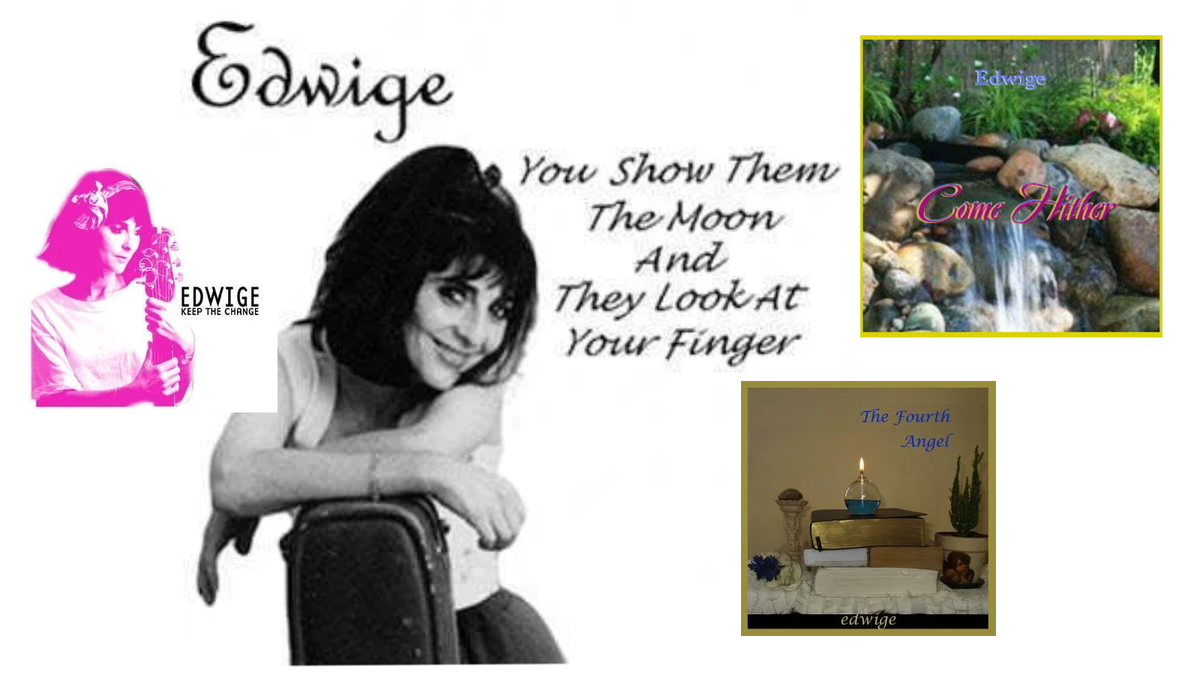
Changing in the morning between the Victoria and Central line at the Oxford Circus tube stop, a clear and eerie song echoes through the serpentine curves of the tunnel, pouring from Edwige’s tiny birdlike body. She disrupts a gush of people, mechanical train screeching and the grim shuffle of commuters.
Edwige has bright eyes under a jet-black fringe and a hard-to-place age. She wears high-heeled sandals and a bow, and is clearly French. As the crushing flood of bodies intensifies, her voice floats high above.
The songs are hard to describe – they sound like church music, but also bring to mind Kate Bush or some lullaby by an extraterrestrial. Some of the tunes are folky, with pop-inspired choruses. Others sound firmly hymnal.
Edwige has an artful tendency to hint at divinity. Instead of pointing at the holy, it feels like she is describing it through the corner of an eye. In the song ‘To Discover,’ she sings ‘After you have given love the name of your fantasy. And granted your emotions with a lifetime guarantee. You still have to discover love.’
Other times, the topic of God is direct, such as when she sings ‘When I hear your word, your love shiiiiiiiines down on me,’ in tinkling cascades, while describing the unsealing of the little book of Daniel in the Bible.
However, Edwige was not raised religious – once her faith, now central to her work, was only hinted at on the horizon.
The hunt.
Edwige was introduced to me by a friend who was entranced one morning by her music and stopped to chat. He said I should definitely interview her, although he wasn’t clear what about.
The business card handed to me features a shining, silver-gilded angel and small text reading ‘(pronounced as edueezh)’ printed helpfully below her name. There is also her website, www.edwige.co.uk. Holding it, I feel a strange feeling, and agree I should interview her, although I also don’t know what about.

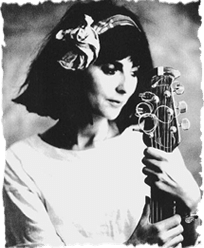
We meet in the cafe on the 5th floor of a John Lewis department store, the definition of a liminal space. In the train station, Edwige seems like a character. Outside of it, she is somehow more fantastical. People turn their heads to watch her drag her guitar case through the cafe, stomping determinedly in heels. She radiates a happiness that is almost chilly.
Edwige has chosen this particular cafe because, unlike other branches, they do not play music. She is choosy. My friend and I suddenly feel formal and awkward. I begin to ask meandering questions about her life.
Her life.
Edwige left home in her teenage years in a dogged search for ‘The Truth,’ abandoning a promising degree in mathematics in France, her home country.
‘When I was five years old, I was walking to the kitchen, and I knew I was here to do something different,’ Edwige says, ‘I had to leave my parents because I knew if I stayed there I would end up like them, and I would die.’
‘It was hard to make the decision because I had nowhere to go, spiritually or physically,’ she said, ‘It felt like plunging into a void.’
For years, Edwige experimented with faith, spirituality, and music, wandering across Europe and to the USA, eventually landing her in London. After an initial dalliance, she shunned producers and big record labels, hating how they interfered with her process. Guaranteeing money or stability was difficult.
‘A lot of people go to music because they want to be rich and famous. It’s not something I ever wanted. I didn’t want to use the gift for personal gain. I wanted to let the gift use me,’ she said.
In these years, Edwige describes her relationship with God as ‘blind faith’ – trust without knowing in what. In an early song, My sure dream, she sings, ‘I have dreamt of you, you beyond time, who’d shake the unrelenting rhythm of the wind, but wherever I go, you are not announcing yourself. Still, I trust in my sure dream.’
In the UK, Edwige eventually found herself living with the owners of a vegan health-food store. They gifted her ‘The Great Controversy,’ a book by the Seventh-day Adventist Ellen G. White, which philosophises on the history of sin. This gift, along with reading White’s ‘Desire of Ages,’ converted Edwige firmly to Christianity.
‘I said that’s it, that’s what I’ve been looking for all my life,’ she said. ‘And I realised God had guided me all these years to be ready to accept him. [...] I had the most beautiful private baptism in a river lake in summer, I was all in white.’
After her conversion, Edwige’s music takes on a certainty it had lacked before, with more overt reference to holy texts. Songs such as ‘Troublous Times’ play the familiar preacher’s role.
Today, she is suspicious of organised religion, and especially dislikes the Pope. But she goes to church, studies the Bible, and prays. For now, London is her home.
I tend to prefer Edwige’s more subtle songs. They hold a painfully familiar feeling of unknowing love, whereas the overtly Christian is deeply unfamiliar to me. I am lustful and anti-establishment, and for most of my life, I have been agnostic. But key lessons hold.
The gift.
Edwige maintains she has never taken her talent for granted – she sees it as a gift, not a product.
‘I never took it for myself,’ she says of her singing. ‘I wanted to render justice, and to be grateful.’
Yes, of course, we need to eat. As Richard Powers says, ‘There comes a moment [...] when you must turn your pretty backwater sector of the universe into a revenue stream.’ Still, I think we can all find a line somewhere and do ourselves better justice by refusing to cross it.
Writer Freddie DeBoer points out that selling out is no longer frowned upon the way it used to be. Our modern-day ‘culture of permission’ wrongly convinces us that life is too hard to defend your art, too hard to get off your phone, too hard for anything you don’t want to do.
 Freddie deBoer
DeBoer writes, ‘Faced with the awful financial conditions for media that have predominated in the 21st century, the industry has collectively decided that we can’t afford to tell people anything other than what they want to hear. And it’s all buttressed by the omnipresent, false belief that now is a particularly hard time to be alive.’
For Edwige, the compromise was turning down record deals to busk in the underground and record music on her own terms. For me, it currently means writing for my local newspaper instead of better-funded but often evil national outlets.
Edwige reminds me to love what I do out of necessity. You can lose your love by allowing pay and admiration to eclipse it. Never sell your gift – it’s rude.
Protecting this love protects what I see in hindsight as my earliest spiritual experience, the strong and painfully true feeling that I am here to write. I can only write well if I can write lovingly. I can only write well because I am loved.
God.
I realized I believed in God in 2020. It was the dead of the first winter of the COVID pandemic, I was in love for the first time, and I was pulling an all-nighter to write an essay for a degree that felt increasingly hollow. Life was painfully beautiful, but also cold, depressing, and limiting.
My entire life, I had been too fearful to fall in love, because I thought it might hurt. It did, a lot. In a terrifying leap of faith, I had laid down my weapons. I felt like a soft-shelled crab surrounded by seagulls. I felt fucking crazy. I was in constant stress while hoping desperately for the impossible: a sign that my lover could hold everything inside me while guaranteeing my total safety. It never came, but it was too late to turn back.
My essay drew on a paper by Edith Stein, a German philosopher and Catholic nun. Stein was critiquing her colleague at the time, the existential philosopher Martin Heidegger. Heidegger was a Nazi who lived to the ripe age of 86. Stein, due to her Jewish ancestry, was murdered at age 50 in the gas chambers at Auschwitz.
Heidegger had once said, ‘Philosophical research is and remains atheism.’ His bleak writing turns the drama and mystery of life into an exhausting, clerical argument with the concept of existence. For Stein, nothing could be further from the truth.
She writes: ‘[Heidegger’s investigation] leaves no room for what gives human life fullness: joy, happiness, love. [...] [Existence] is for him emptied to the point of being a sequence from nothing to nothing. And yet, it is rather the fullness that first really makes it understandable why the human being is ”‘about its being.”
So, Heidegger's obsession is that we come from nothing and head towards nothing. But Stein points out that we only become aware of nothing, this cold backdrop, by being, in some way, endless and loved.
Without fullness, there could not be a void. Without an always, there is no now. And without love, how could there be love? At that moment, my stomach aching from coffee, I was able to fully accept that I believe in God, without religion or a holy book. No longer needing to be fully reliant on myself, no longer asking anyone else to provide me with safety. It felt like a gift.
The endless flow.
I have never tried to define God much further than the feeling I had in that moment. Although Edith Stein led me to water, the moment I drank can not be described, and had more to do with sensation than reasoning. I do not observe any religious laws or subscribe to any ideas on the afterlife, and I believe organised religion is often an unnecessary source of fear, guilt, and bigotry.
But I love the feeling of believing, reaching out and up into endlessness, knowing it will respond. To me, it is very similar to the feeling commonly known among artists as ‘flow’.
When in a state of flow, time is fast, and the creative process feels seamless and effortless. For most artists, a state of flow is both where their best work is produced and where they enjoy their craft most. It is an almost trance-like, incredibly productive mindset that people spend their lives chasing.
Although they can agree that they would like to enter flow, artists all seem to have different ways they try to explain it. One of the most memorable descriptions I’ve heard is by popular Irish podcaster Blindboy, describing the process of writing his book of short stories.
‘Remember Play-Doh?’ he begins, ‘Well, there were these lads on the internet, and they were making these things for their arses, and they were shitting shapes through these... and shitting like big long gogs in the shape of stars and triangles.’
‘It's like your unconscious are your bowels, and then your talent in your conscious mind are these star and triangle shaped things that you strap to your arse, so you shit and then the talent shapes it into a shape,’ Blindboy continues, ‘So that’s what writing the book was like, terrible fucking metaphor for such a beautiful experience, but that's what writing the book was like for me, I achieved the state of flow.’
Influencer Sighswoon describes approaching flow on X with a video: a woman, presumably an athlete, strapped to a horse. The horse is running very fast, and the woman cycles through poses on its back, sometimes elegant and ballet-like, with her arms spread out delicately, other times limp and bouncing comically, looking alarmingly like a rag doll. Somewhere in between the surrender and the poise, the two are in perfect harmony, running together.
Me trying to achieve flow state pic.twitter.com/PKYpwZRe7T
— ⊹ (@sighswoon) June 8, 2024
Coincidentally, Sighswoon has described God on her podcast in one of my favorite ways. ‘When you go into a museum, and you see [some art], and you’re like, oh my God, what is going on, what does it mean [...] that is what God is,’ she says. ‘God is this constant interpretation, this constant feeling of meaning-making that never fully lands. It’s just there, and it’s just more meaningful than any meaning.’
Like the flow state, God feels both like hard work and the easiest thing in the world. You need to wiggle around, empty yourself, be present – but once you do, ‘it’s just there,’ endlessly there.
I realise now that the entanglement between Edwige’s flow state and her relationship to God is what I was seeking to understand when we spoke. Because she cares about little else, her art practice feels archetypal. The beautiful clarity of her process and her music are great gifts she has given me. I don't believe that either of us is "right" or "wrong" about God. I believe we are addressing our letters to the same place.
Edwige describes her state of flow as listening to a very quiet voice. ‘If your mind is full of [other] voices because of thoughts, worries, it is more difficult to hear it,’ she says, ‘it gives you the idea, and then you have to work on it.’
For Edwige, the flow is a gateway to a faith which is an active work in progress. After the initial bolt of understanding comes the study and the work. ‘God is not just a concept, it’s a reality, and it has to be manifested in life otherwise it’s not a reality,’ she said.
For myself, I only really know that I want and need to keep writing. Maybe for me, this also means I am praying? One of Edwige’s lyrics keeps me company, floating in my mind. ‘I am wherever it is, with you.’